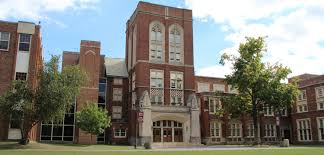
Scarsdale School Officials Address Antisemitism
At last month’s meeting of the Scarsdale Board of Education, School Superintendent Dr. Drew Patrick made the following statement addressing the recent antisemitic incident at Scarsdale High School, in which fliers from the Israeli Culture Club were ripped from the walls and thrown into urinals in the boys bathroom.
“Our community is hurting deeply, and is wondering what it means for the future, and what comes next. I have served as Superintendent for four years, and in that time I have been guided by two unwavering principles—our work must be driven by the needs of our students, and trust with our community requires honesty and transparency. As we gather tonight, I say to you honestly and transparently that moving forward will require the collective work of our entire school community. That means that we are listening, seeking to learn from all of the feedback we are receiving, and putting our deepest, most concerted effort into promoting a safe, welcoming, positive school environment with the tools at our disposal–education, policy, and dialog.
We are living in divisive times. Our country is engaged in conflict on the other side of the world. Our domestic politics feel increasingly polarized. And members of our community are feeling the impact of these larger forces in very personal ways. When global issues reach into our schools, into our shared spaces, into our homes, we feel it deeply. Many of you are here tonight because you are carrying both what has happened here and what is unfolding in the broader world.
It must be said clearly: We are also living through a moment in which concerns about anti-Jewish hate have intensified in ways that are deeply felt by Jewish families in our community, contributing to a palpable sense of fear, vulnerability, and destabilization. National data helps explain why: Although Jews make up roughly 2 percent of the U.S. population, they are the target of nearly 70 percent of religion-based hate crimes. Jews have been murdered in antisemitic attacks in the United States in Washington, DC, Colorado, Pittsburgh and elsewhere, attacked physically in communities across the country, and targeted in violent incidents in places like London, Australia, France, Belgium, and Canada.
At the same time, hate-fueled violence is not limited to any one community. Multiple minority communities are also experiencing heightened bias, hostility, and fear. Here in the United States, we have witnessed the shooting of Palestinian university students in Burlington, Vermont and the murder of a six-year-old boy because he was Palestinian. It is not surprising that these broader dynamics cause members of our own community to carry their weight. But bias, hostility, violence, and fear have no place in our country. As Viktor Frankl wrote after surviving the Holocaust, there is a space between what happens to us and how we respond—and in that space lies our freedom to choose what comes next. We are in that space right now. Tonight. Together.
As an educational institution, we are holding closely to that idea. The students in our care—and the adults in this community—are being asked to navigate a difficult moment. Between events that have caused pain and the actions we take next, there is an opportunity to be deliberate and to act in alignment with our values: kindness, respect, care, and empathy for all. It is also true that, in recent weeks, some of those values have felt strained.
The intersection of advocacy, politics, and bias in this moment can cloud our ability, and at times our willingness, to acknowledge when harm is happening, including in our own community. While that may be a human instinct, it cannot be where we stop. We remain responsible for engaging these realities with clarity, care, and accountability.
In this community, we will not rank suffering or turn away from one another. We stand with our Jewish neighbors, and with anyone targeted by hate, bias, or harassment. That commitment to the safety and dignity of every member of our community is foundational to who we are.
As an educational institution, we are guided by a core premise: when issues become difficult, we do not avoid them, we turn toward learning. Education gives us a framework for naming what we are seeing, understanding how bias operates, and building the skills required to respond thoughtfully rather than reactively. That includes being clear about how anti-Jewish bias manifests today, sometimes overtly, sometimes in more coded or distorted ways, and ensuring that our response strengthens, rather than fragments, our broader commitment to the dignity and safety of all members of our community.
In the near term, we will be putting forward a structured plan to move this work ahead. One component of that includes new Guidelines for Student Expression at School-Sponsored Activities, which appear in tonight’s agenda. These guidelines have been developed in consultation with experts, and a link appears in Item 12.01 for members of our school community to share feedback. That may include the opportunities for input through surveys and small, facilitated focus groups, as well as engagement with outside experts who can help us assess where there may be gaps in knowledge and skills, particularly around civil dialogue and engaging across differences. This moment has surfaced the need to strengthen those capacities, and we are actively considering how to ensure that our students, especially at the high school level, graduate with stronger skills in these areas as they prepare for college and beyond.
In the medium term, I am honored to announce some important news. After many months of collaboration and preparation, we will be introducing a new program to our schools next year called The Common Circles Experience: Scarsdale. The program features two connected parts: We Are Scarsdale! Bridging, Belonging & Building Community and Voices Against Hate: Lessons from the Holocaust. We are very excited about the opportunities for students, faculty, families, and community members to help shape and become part of the experience itself through local stories, photography, art, and participation. The program is an immersive research-based experience that blends art, technology, and storytelling to explore our shared humanity, build community, and teach the lessons of the Holocaust. In a moment marked by growing polarization, rising antisemitism, and increasingly dehumanizing rhetoric, the exhibition celebrates identity and strengthens historical understanding while inviting reflection. Above all, the experience encourages dialogue and fosters a space where everyone is seen, heard, and valued.
While these are important steps, we also need to continue to listen to our community. Tonight is part of that process, and your perspectives will help shape what comes next. We will share more details about those next steps in the coming weeks.
I want you to know that we see you, and we understand that this has been a challenging moment.
Our goal tonight is to listen carefully, to learn, and to take responsibility for how we move forward. We are committed to doing that work with seriousness, with care, and with a clear sense of our responsibility to one another. The fact is, we can’t do it alone, and we can’t do it all in a matter of days. But we will move forward as a school community, together—students, teachers, administrators, staff, parents, our Board of Education and our broader community.”
School Board President Suzie Hahn began her opening comments with the following statement:
“I would also like to address the last several weeks. I will be honest, this has been a challenging time. We care deeply about every member of this community, and we have seen the genuine concern, pain, and worry that many of you are carrying. To reiterate a recent letter to the community from the Board, this Board condemns, in absolute terms, all forms of antisemitism, hate, and discrimination. We are committed to creating and sustaining learning environments in our schools that reflect our values of dignity, respect, inclusion, and safety that we strive to uphold for every student.
One of our board members recently shared that the Mandarin word for “crisis” describes a moment of danger and a critical turning point—and within that turning point, the opportunity to shape what comes next. We intend to meet this moment with that mindset, to engage it seriously, to learn from it, and to do the work required to emerge stronger as a community of students, faculty, and families.
To that end, I would like to share that on April 22, members of the Board participated in a full-day workshop at Purchase College entitled, “Identifying and Addressing Antisemitism in our Schools,” presented by Brandeis University’s President’s Initiative on Antisemitism and Boundless, in partnership with Westchester Jewish Council and UJA-Federation of New York. This training focused on how anti-Jewish bias and hate manifests in today’s schools. Board members have also over the last few months experienced the Common Circles exhibit Drew mentioned in his earlier comment, and have approved a transfer to allocate funds in our budget to help bring this exhibit, to increase empathy, reduce bias and antisemitism, to Scarsdale.
These are important steps, but they are not sufficient. We are committed to continuing this work, and to ensuring that we are educated about all forms of bias and hate, so that none of them can take root or go unaddressed in our schools.”